


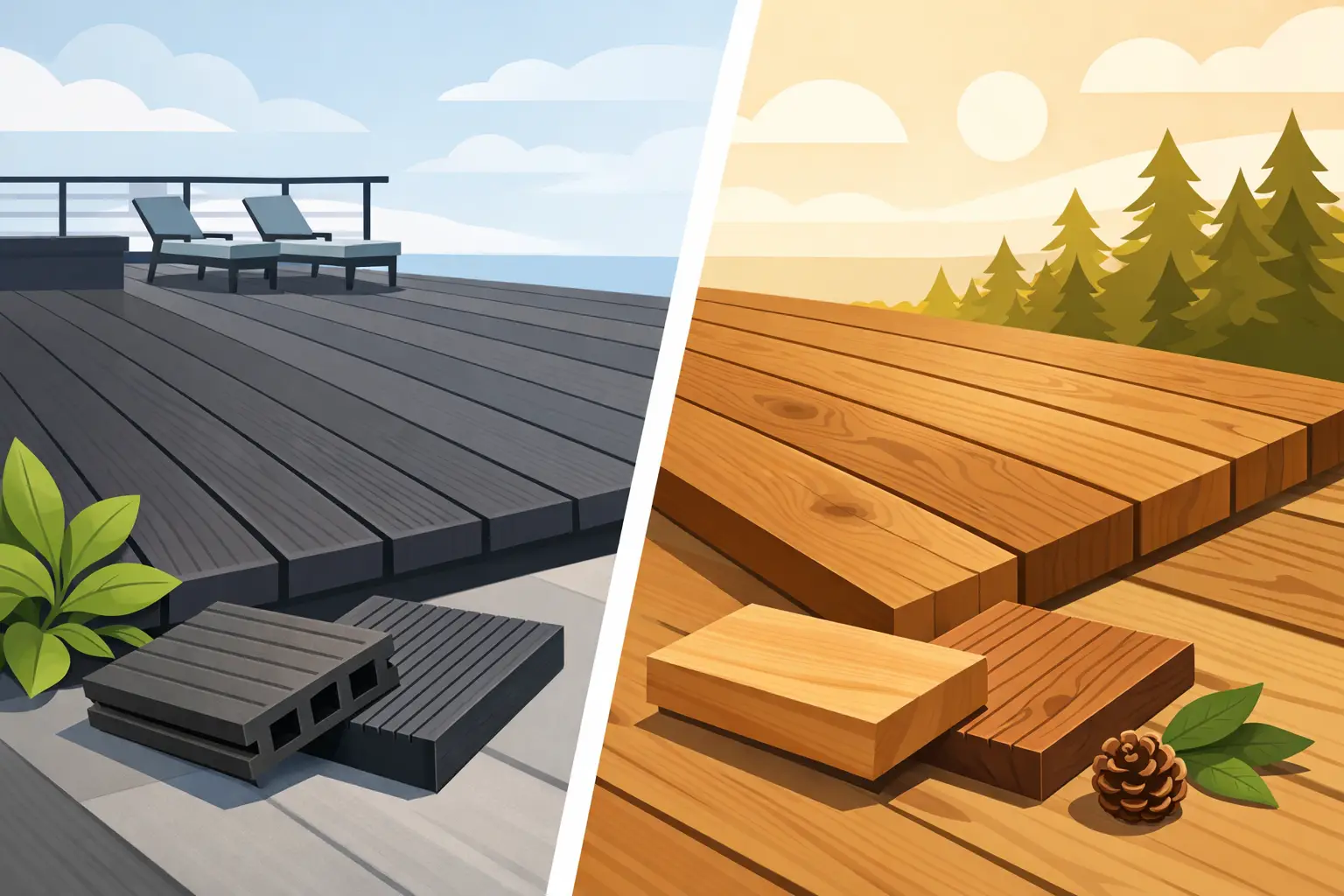
When a deck is exposed to full sun, standing water, freeze-thaw cycles, and constant foot traffic, material choice stops being a design preference and becomes a performance decision. That is why the WPC decking vs wood conversation matters early in planning, especially for builders, contractors, and property owners who want fewer callbacks and better long-term value.
Both materials can deliver an attractive finished space. The difference is how they behave after a few seasons of weather, cleaning, use, and maintenance. For some projects, natural wood still makes sense. For many others, WPC decking offers a more predictable result with less ongoing labor.
WPC decking vs wood at a glance
Wood-plastic composite, commonly called WPC, is manufactured from a blend of wood fibers and recycled plastic, typically with protective additives and a capped surface layer. It is designed to give the look of wood while reducing some of wood’s natural weaknesses, especially moisture absorption, splintering, and repetitive maintenance.
Traditional wood decking includes pressure-treated lumber, cedar, redwood, and hardwood species. Each wood option performs differently, but all remain organic materials that react to moisture, temperature, sunlight, and biological exposure over time.
If the project priority is natural grain variation and lower upfront material cost, wood may remain in the conversation. If the priority is durability, low maintenance, and appearance retention, WPC is often the stronger specification.
Appearance and design flexibility
Wood has one advantage that is easy to understand – it is authentic. The grain, knots, variation, and aging pattern are natural, and for some residential applications that character is exactly what the owner wants. High-end wood species can create a warm, premium look that many people still prefer.
WPC decking has improved significantly in this area. Better embossing, richer surface textures, and more refined color development have narrowed the visual gap. More important for many projects, WPC offers consistency. Boards are more uniform in color and profile, which helps on larger decks, multifamily builds, rooftop amenity spaces, and commercial applications where a cleaner, more controlled appearance is preferred.
Customization also matters. For projects that need a specific color direction or coordinated exterior palette, a building products supplier with custom design capability can make WPC a practical choice when standard lumber options feel limiting.
How appearance changes over time
Wood changes quickly if it is not maintained. UV exposure can gray the surface, water can stain it, and repeated expansion and contraction can affect visual consistency. Some owners like weathered wood. Others do not.
WPC tends to hold its intended look more reliably. There can still be some initial weathering depending on the product, but the surface generally resists fading, staining, and moisture-related discoloration better than standard wood boards. On projects where long-term visual consistency matters, that stability is a real advantage.
Durability in real-world conditions
This is where the performance gap usually becomes clearer. Wood is structurally capable, but it is vulnerable to moisture, insects, rot, checking, cracking, and splintering. Pressure treatment helps, but it does not eliminate maintenance or aging.
WPC decking is engineered to reduce those issues. It does not absorb water the way wood does, and it is not prone to the same type of rot or insect damage. In climates with heavy rain, humidity, snow, or frequent freeze-thaw cycles, that matters. A deck that stays more dimensionally stable is easier to maintain and often performs better over time.
For pool surrounds, coastal environments, shaded backyards, and commercial outdoor areas with heavy use, WPC generally offers a more reliable surface. That does not mean it is indestructible. It can still scratch, heat up in direct sun depending on color, and require correct installation spacing and support. But compared with wood, it usually creates fewer long-term performance problems.
Moisture resistance and movement
Wood expands and contracts with moisture content. That can lead to warped boards, raised fasteners, and uneven surfaces. It can also create labor demands beyond the original installation, especially if the deck is expected to look polished year after year.
WPC also moves with temperature, so installers need to follow manufacturer guidelines carefully. The difference is that its movement is more predictable and less tied to water absorption. In practical terms, that often means fewer issues related to swelling, splitting, and surface breakdown.
Maintenance and lifecycle labor
Maintenance is one of the biggest decision points in the WPC decking vs wood comparison. Wood usually needs regular staining, sealing, cleaning, and inspection. Depending on exposure and species, that cycle may start sooner than the owner expects.
For a homeowner, that means weekend labor or ongoing service costs. For a commercial property owner, it means maintenance budgets and disruption. For contractors, it can also mean client dissatisfaction if maintenance expectations were not clearly explained from the start.
WPC decking requires cleaning, but not the same level of surface treatment. There is no annual staining schedule and no need to sand splinters or replace boards that have started to rot from the inside out. Over the life of the deck, that lower maintenance burden is often what shifts the value equation in favor of composite.
This is especially relevant for clients who want premium exterior finishes without committing to a high-maintenance ownership experience. That group continues to grow in both residential and commercial segments.
Cost: upfront price vs long-term value
Wood usually wins on initial material cost, especially if pressure-treated lumber is the baseline. That lower entry price can be attractive on budget-sensitive builds or short-term ownership scenarios.
But initial cost is only part of the picture. Wood carries recurring costs in sealers, stains, repairs, labor, and earlier replacement of damaged boards. Those expenses can close the gap faster than many buyers expect.
WPC often costs more upfront, but it tends to offer stronger lifecycle value. When maintenance is lower and service life is longer, the total cost of ownership can be more favorable. For developers, builders, and property managers, that predictability matters. A material that reduces long-term upkeep can support better budgeting and lower operational friction.
If the project is being built for resale in the near term, wood may still pencil out. If the owner is planning to keep the property and wants stable performance, WPC is often the better financial decision.
Installation considerations
Neither material should be selected without looking at installation conditions. Wood is familiar to most crews, widely available, and relatively straightforward to cut and fasten. That familiarity can help on jobs where speed and basic material access are the top priorities.
WPC decking typically benefits from more precise installation practices, including proper gapping, substructure alignment, ventilation, and fastener selection. Those are not drawbacks so much as specification requirements. When handled correctly, the finished system tends to look cleaner and perform more consistently.
On higher-end projects, hidden fastening systems and more refined board profiles can also improve the final appearance. That said, installers need to work from the right technical guidance. Product quality and supplier support make a difference here.
Where wood still makes sense
Wood is not obsolete. It can still be the right choice for certain custom homes, rustic designs, and projects where natural material authenticity is the top priority. It can also work well when the owner accepts maintenance as part of the product and plans to refinish the deck regularly.
There are also cases where a historic context or architectural style calls for real wood. In those situations, the correct species, treatment level, and maintenance plan matter more than ever.
Where WPC is usually the better fit
WPC is often the stronger option for projects that need long-term durability, appearance retention, and low maintenance. That includes multifamily developments, hospitality settings, mixed-use properties, pool decks, rooftop terraces, and premium residential builds where owners want performance without constant upkeep.
It is also a smart fit when weather resistance is a major concern. In regions with moisture swings, heat, snow, or repeated seasonal stress, engineered decking can reduce many of the familiar problems associated with natural wood.
For buyers evaluating specification-ready materials, this is where an experienced supplier adds value. At First Class Building Products, the focus is not just on supplying boards. It is on helping customers match material performance, finish expectations, and project demands with the right exterior solution.
Choosing the right material for your project
The best answer is not based on trend. It comes down to use case, climate, budget, ownership horizon, and maintenance expectations. If the deck needs to stay sharp with minimal intervention, WPC usually has the edge. If natural texture and lower initial spend matter most, wood may still be a reasonable fit.
A deck is one of the most exposed surfaces on a property. Choosing the right material at the start can save years of maintenance, repairs, and avoidable frustration later. The better question is not which material is more popular. It is which one will still be working for the project five or ten years from now.

Leave a Reply